Listed Building
The only legal part of the listing under the Planning (Listing Buildings and Conservation Areas) (Scotland) Act 1997 is the address/name of site. Addresses and building names may have changed since the date of listing – see 'About Listed Buildings' below for more information. The further details below the 'Address/Name of Site' are provided for information purposes only.
Address/Name of Site
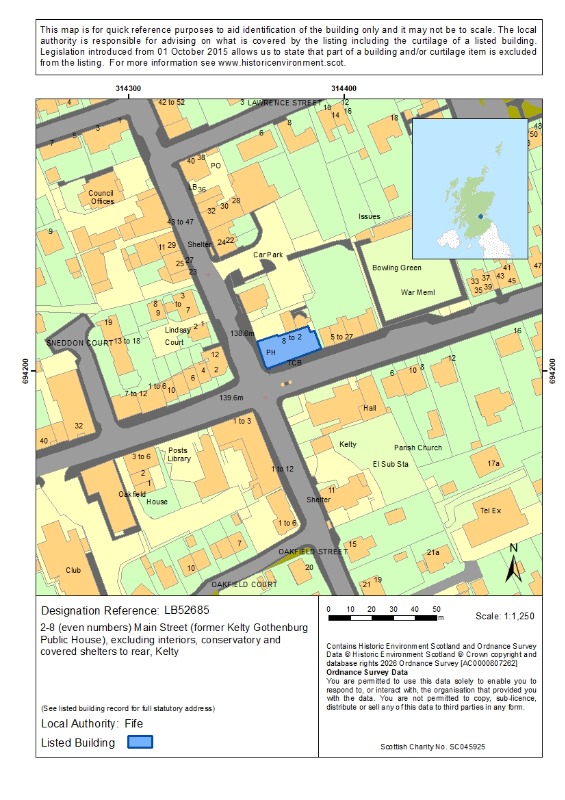
2-8 (even numbers) Main Street (former Kelty Gothenburg Public House), excluding interiors, conservatory and covered shelters to rear, Kelty LB52685
Status: Designated
Summary
- Category
- C
- Date Added
- 06/08/2026
- Local Authority
- Fife
- Planning Authority
- Fife
- Parish
- Beath
- NGR
- NT 14375 94212
- Coordinates
- 314375, 694212
Description
A two-storey gabled public-house on a corner site, built 1899-1900 and extended in 1903 and 1907 by Andrew Scobie of Dunfermline. The building is L-shaped on plan and constructed in squared-and-snecked sandstone with stone skews, slated roofs and gable stacks. It has a seven-bay elevation to Station Road and a three-bay elevation to Main Street with a canted corner entrance bay to the southwest with a curved corner conical tower above. The building is prominently located on the principal crossroads of Kelty at the south end of Main Street.
The street elevations are asymmetrical and interspersed with three prominent gabled bays with gables flanking the corner turret. Each has an apex chimneystack (the western one on Station Road has been truncated) and a segmental pediment over the first-floor windows with bracketed moulded cornice and surmounted by engaged ball finials. The windows throughout are a mixture of single openings and bipartites with a central stone mullion, all with plain stone margins and replacement casement windows. Some openings have been blocked up to the ground floor.
The main entrance is in the angled corner bay and has keystoned, round arched doorway; the door (a replacement) is recessed with a plain fanlight above. The curved corner tower corbels out above this, with a curving tripartite window, conical roof, finial and parapet. A moulded string course extends along both the street elevations and wraps around the corner tower at first-floor level with a timber signage fascia below.
There are multiple secondary entrances on the two principal elevations including two built up with blockwork on Main Street. The rear elevations are largely roughcast rendered. The north-facing gable of the Main Street wing has a tall round arched window and the walling has been painted over with a mural (around 2019). To the rear (north) are a pair of single-storey outshots with piended roofs, and other later 20th and 21st century extensions. These include a single storey conservatory and covered shelters.
The interiors are understood to largely date from the late 20th to early 21st centuries.
Historical development
The Kelty Gothenburg Public House was built in 1900 and is first shown on the Ordnance Survey 3rd Edition (Revised 1913, Published 1915) marked as a public house beside the Oakfield crossroads. In the 1850s the site had been occupied by a small coal pit, but it was vacant by the 1890s. The village of Kelty was largely developed after 1872 when the Fife Coal Company bought the pits of the Beath and Blairadam Colliery at Kelty and began expanding operations there. Over the next two decades, there was a large amount of development to the east of Main Street, particularly along the branch of the crossroads extending towards Kelty Station (renamed Station Road). This included the Gothenburg Pub, the bowling green and the parish kirk (listed at category C, ref: LB43859).
The Kelty Gothenburg Public House operated on the model of the Gothenburg Public House System, a method of controlling the consumption of spirits which had originated in the 1860s in Gothenburg, Sweden. The system saw alcohol licenses restricted to approved retailers organised as a trust to reinvest profits from the sales of alcohol into the community to provide educational and recreational facilities, with the stakeholders receiving a maximum of 5% return. The first Gothenburg public house in Scotland was set up at Hill of Beath near Kelty in 1896 by John Ross, a Dunfermline solicitor who was agent to the Fife Coal Company and known for his involvement in educational and social reform. The Gothenburg System became popular in the mining communities of central Scotland, which were growing rapidly in the late-19th and early-20th century and required amenities to support the miners. At its height there were more than 20 Gothenburg pubs (known as 'Goths') in Fife, as well as others in the Lothians, Stirlingshire and Ayrshire.
The Kelty Public House Society was established on 1 January 1900 by John Ross to introduce the Gothenburg System to Kelty, despite strong opposition at a public meeting the previous autumn. Their premises was constructed at Ross's expense for £3,500 possibly to designs by Andrew Scobie of Dunfermline who extended the building in 1903 and 1907. The building had a large bar with a separate jug compartment (a type of off-license for selling alcohol to take away) and four rooms off the bar. In the wing on Main Street was a restaurant room with a separate street entrance. On the floor above was a flat for the bar manager and a large function room with a capacity of 70, used for cricket club dinners, Burns' Suppers and concerts.
Like other 'Goths', the aim of the Kelty public house was to discourage drunkenness, particularly the consumption of low-quality spirits. Beer and wine were encouraged as alternatives, and the bar was closely policed by the manager to maintain respectability.
By 1921, Kelty was described as having 'the most important Gothenburg in Scotland' (Dundee Courier, 21 Feb 1921, p. 2) and the Society operated three different public houses in the village with profits of £3,514. To distinguish it from the society's other establishments, the original public house was thereafter named 'Gothenburg No. 1' or 'No. 1 The Goth'.
The Kelty Gothenburg was still operating according to the original principles in 1960 but became a regular public house later in the century and continued to trade as No. 1 The Goth until around 2019. The eastern part of the building was divided off and used as a separate restaurant in the 1990s.
Statement of Special Interest
Kelty Gothenburg Public House meets the criteria of special architectural or historic interest for the following reasons:
- It has special historic interest for its links to the Temperance Movement and the Swedish Gothenburg public house system, providing improved quality of life in Scotland's mining communities.
- It is amongst the earliest public houses built as part of the Gothenburg movement.
- It remains largely unaltered to its exterior and retains much of its original early 20th century character to its principal elevations.
In accordance with Section 1 (4A) of the Planning (Listed Buildings and Conservation Areas) (Scotland) Act 1997 the interiors, conservatory and covered shelters to rear are excluded from the listing.
Architectural interest
Design
Kelty Gothenburg Public House is a good surviving example of a purpose-built public house that operated on the model of the Gothenburg Public House System. Gothenburg pubs were designed in a variety of architectural styles. Kelty Public House has some notable features including a prominent corner entrance with its Scots Baronial style tower and good quality stonework throughout.
The external appearance of Kelty Public House has remained largely unaltered. Some openings have been blocked up, there are some modern additions to the rear, and windows have been replaced. However, these changes are minimal and do not detract from the overall character of the building. The additions to the rear, which include a conservatory and covered shelters, as well as the interiors are not of special interest and are excluded from the listing.
Setting
Kelty Gothenburg Public House is located on a corner site along one of the main thoroughfares and is prominent within its setting.
The original building plot of the pub is largely unaltered. The Kelty Kirk and Hall (listed at category C, ref: LB43859), is near-contemporary in date (1894-96) and is located directly opposite the public house. Other 19th and early 20th century buildings (a public house and a picture theatre) have since been replaced by modern housing development and commercial buildings. The former Gothenburg pub now remains as a notable historic building in a multi-period townscape.
Historic interest
Age and rarity
Public houses are not a rare building type and can be found in settlements across Scotland. Kelty Gothenburg Public House in Kelty is of special historic interest as an early and relatively rare surviving example of a purpose-built 'Goth' pub that survives largely in its original form and with much of its early 20th-century character still evident to the exterior.
Gothenburg pubs, or 'Goths', were popular around the turn of the century in various mining areas in Scotland, especially in Fife and Lothian. Kelty Gothenburg Public House is one of the earliest surviving 'Goth' pubs in Scotland, opening in 1900 shortly after the first one opened in 1896 in the nearby in the Hill of Beath (see section 2.2). Other early examples include the Dean Tavern in Newtongrange (1899) (listed at category at C, ref: LB46971), 'Glencraig', in Ballingry, Fife (1905), Bowhill Public House, also in Fife (1904) (listed category C, ref: LB43654), 'Black Bull' in Dalkeith (1905-06) (listed at category B, ref: LB24335) and Prestongrange Gothenburg pub in Prestonpans (1908) (listed at category B, ref: LB40324). The examples in Newtongrange, Prestonpans, Fallin and Armadale still operate under the Gothenburg system (2026).
Social historical interest
Social historical interest is the way a building contributes to our understanding of how people lived in the past, and how our social and economic history is shown in a building and/or in its setting.
Gothenburg public houses, also known as 'Gothenburgs' or 'Goths' (originating in the Temperance Society of Gothenburg, Sweden) were drinking places, run by a committee, with profits distributed to worthy causes. There was a growing concern about the abuse of alcohol and drunkenness among the working classes during the 19th century. Campaigners at the time looked to the example set in Gothenburg in Sweden.
Kelty Gothenburg Public House has special historic interest as it illustrates the growing aspirations of the working population to engage in sociability whilst also carrying out charitable activities to provide local amenities for the benefit of the wider community. The nearby bowling green, which was funded by the Kelty Public House Society, is still in use today.
Association with people or events of national importance
There is no association with a person or event of national importance.
References
Bibliography
National Record of the Historic Environment (NRHE) ID 380835: https://www.trove.scot/place/380835 (accessed on 29/04/2026)
Maps
Ordnance Survey (surveyed 1854, published: 1856) Fife, Sheet 30. Six inches to the mile. 1st edition. Southampton: Ordnance Survey.
Ordnance Survey (revised 1913, published: 1915) Fifeshire XXXIV.3. 25 inches to the mile. 2nd edition. Southampton: Ordnance Survey.
Ordnance Survey (revised 1961, published: 1962) National Grid Map: NT1494-NT1594 - AA. 1:1250. Southampton: Ordnance Survey.
Printed Sources
Dundee Courier (21 Feb 1921) Kelty Gothenburg Grants. p.2.
St Andrews Citizen (29 December 1900) In the Village of Kelty. p.3.
Edinburgh Evening News (17 September 1898) Kelty's Views on the Public-House Experiment. p.4.
Arbroath Herald (10 July 1902) The Kelty "Gothenburg” Pub: Village Bowling Green Presented. p.6.
Bonnar, R. (1964) Stewartie. London: Camelot Press. p.15.
Durland, K. (1904) Among the Fife Miners. London: Swan Sonnenschein & Co., Ltd.
Rowntree, J. & Sherwell, A. (1903) British 'Gothenburg' Experiments and Public-House Trusts. London: Hodder & Stoughton. pp.74-86.
Kelty Public-House Society (1909) Rules of the Kelty Public-House Society, Limited. Dunfermline: R.K. Lindsay & Co.
Online Sources
Scottish Mining Website, Beath Parish at http://www.scottishmining.co.uk/35.html [accessed 23/02/2026]
Historic Environment Scotland, The Goths of Fife and the Lothians at https://blog.historicenvironment.scot/2019/05/goths-fife-lothians/ [accessed 23/02/2026]
Dictionary of Scottish Architects, Scobie & Son at https://www.scottisharchitects.org.uk/apex/r/dsa/dsa/architects?p8_id=203128 [accessed 23/02/2026]
About Listed Buildings
Historic Environment Scotland is responsible for designating sites and places at the national level. These designations are Scheduled monuments, Listed buildings, Inventory of gardens and designed landscapes and Inventory of historic battlefields.
We make recommendations to the Scottish Government about historic marine protected areas, and the Scottish Ministers decide whether to designate.
Listing is the process that identifies, designates and provides statutory protection for buildings of special architectural or historic interest as set out in the Planning (Listed Buildings and Conservation Areas) (Scotland) Act 1997.
We list buildings which are found to be of special architectural or historic interest using the selection guidance published in Designation Policy and Selection Guidance (2019)
Listed building records provide an indication of the special architectural or historic interest of the listed building which has been identified by its statutory address. The description and additional information provided are supplementary and have no legal weight.
These records are not definitive historical accounts or a complete description of the building(s). If part of a building is not described it does not mean it is not listed. The format of the listed building record has changed over time. Earlier records may be brief and some information will not have been recorded.
The legal part of the listing is the address/name of site which is known as the statutory address. Other than the name or address of a listed building, further details are provided for information purposes only. Historic Environment Scotland does not accept any liability for any loss or damage suffered as a consequence of inaccuracies in the information provided. Addresses and building names may have changed since the date of listing. Even if a number or name is missing from a listing address it will still be listed. Listing covers both the exterior and the interior and any object or structure fixed to the building. Listing also applies to buildings or structures not physically attached but which are part of the curtilage (or land) of the listed building as long as they were erected before 1 July 1948.
While Historic Environment Scotland is responsible for designating listed buildings, the planning authority is responsible for determining what is covered by the listing, including what is listed through curtilage. However, for listed buildings designated or for listings amended from 1 October 2015, legal exclusions to the listing may apply.
If part of a building is not listed, it will say that it is excluded in the statutory address and in the statement of special interest in the listed building record. The statement will use the word 'excluding' and quote the relevant section of the 1997 Act. Some earlier listed building records may use the word 'excluding', but if the Act is not quoted, the record has not been revised to reflect subsequent legislation.
Listed building consent is required for changes to a listed building which affect its character as a building of special architectural or historic interest. The relevant planning authority is the point of contact for applications for listed building consent.
Find out more about listing and our other designations at www.historicenvironment.scot/advice-and-support. You can contact us on 0131 668 8914 or at designations@hes.scot.
Map
Printed: 24/09/2026 23:01