Listed Building

The only legal part of the listing under the Planning (Listing Buildings and Conservation Areas) (Scotland) Act 1997 is the address/name of site. Addresses and building names may have changed since the date of listing – see 'About Listed Buildings' below for more information. The further details below the 'Address/Name of Site' are provided for information purposes only.

Address/Name of Site

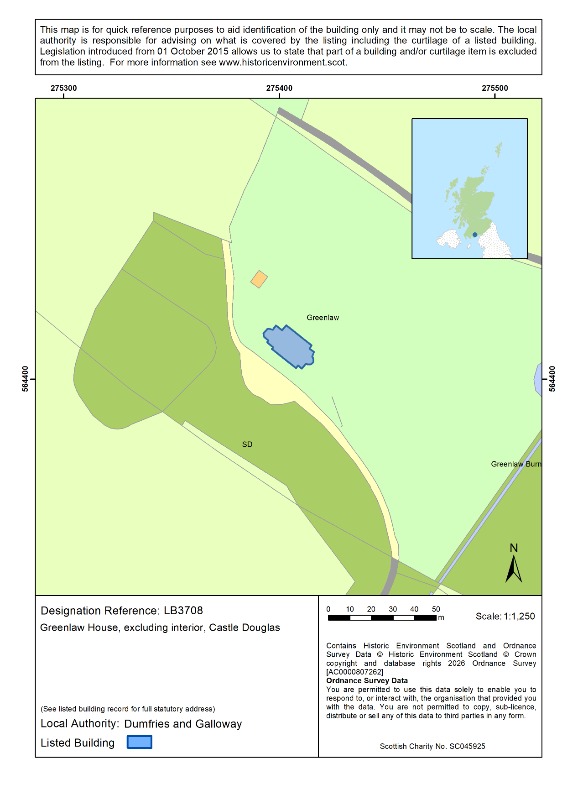
Greenlaw House, excluding interior, Castle DouglasLB3708

Status: Designated

Documents

Where documents include maps, the use of this data is subject to terms and conditions (https://portal.historicenvironment.scot/termsandconditions).

Summary

Category
B
Date Added
04/11/1971
Last Date Amended
02/02/2026
Local Authority
Dumfries And Galloway
Planning Authority
Dumfries And Galloway
Parish
Crossmichael
NGR
NX 75413 64412
Coordinates
275413, 564412

Description

A mid-18th century neoclassical, rectangular-plan, symmetrical, three-storey and attic mansion house with bowed end elevations, set in open parkland. The entrance elevation (southwest) has and advanced 5-bay section with a large, splayed stair oversailing raised basement, leading to a first-floor tripartite entrance doorpiece with fluted Ionic pilasters and arched plain entablature over. The recessed piended end bays have full height bowed three-bay sections to the centre of their return elevations. The building is rendered with quoins to the margins and with corniced eaves. The windows at the piano nobile (principal first floor) are taller; there are Venetian style (round arched) windows to the first flow at the bowed ends. The rear elevation is plainer with an early 19th century pilastered and corniced doorpiece with crest to the centre.

The interior of the building and the roof were reconstructed around 2000. The roof is piended with large, broad ashlar chimney stacks to the side ridges. The roof dormers were added after 2000.

Greenlaw House is first shown on James Dorret's 'A general map of Scotland and islands' of 1750 depicted as a mansion house symbol with annotated name. It is also on the First Edition Ordnance Survey Map (surveyed 1848, published 1853) in its current symmetrical plan form and this footprint appears unchanged since the time it was built. The map also shows a walled garden with outbuildings to the east of the house and another rectangular ancillary building to west. These ancillary buildings are not shown on the later maps.

Greenlaw House was built in 1741 for the Gordon family of Greenlaw and Culvennan (Buildings of Scotland). It remained as a dwelling until some point in the mid to later 20th century when it operated as a hotel.

A fire in 1984 caused significant damage to the interior and by 2000 the roof and interior had been lost, although the building remained complete to wallhead. It was renovated from around 2000 using modern materials to the interior with an internal floor plan similar to the original layout.

Dating to the first half of 18th century, the building is a fine example of a neoclassical house which survives in its largely original form to the exterior. It is an unusual lozenge shape plan which does not appear to have been changed since the time it was built. Although the architect is not known, the proportions of the elevations and scale of the building suggest a classically trained architect was involved in the design. This symmetrical classical design was a fashionable style for smaller scale, regional country houses during the period it was built, and the authenticity of the design remains to the exterior. There are fine classical details such as the sweeping entrance stair and ornate entrance screen as well as a classical doorpiece with coat of arms to the rear.

Most of the interior fabric of the building was lost to fire and was subsequently renovated around 2000. In its current form the interior does not add to the building's special interest.

The building is set in flat open parkland, and both the front and rear elevations of the house are visible from a long distance, appearing as a prominent feature in the landscape. The open setting is characteristic of this style of country house and adds to building's architectural and historic interest.

Dating to the first half of the 18th century, Greenlaw House is a fine, early surviving example of a small villa, designed in the grand manner of a fashionable neoclassical country house. In plan form and design, it defines the classical ideal for a country house of this size and importantly it predates the villa building boom of the late 18th century. While the roof has been rebuilt, the exterior retains its historic character.

Statement of Special Interest

  • Dating to the mid-18th century it is a fine example of a neoclassical house designed with characteristic details such as a symmetrical plan form and elevations and refined classical architectural detailing.
  • Later alterations to the roof have not adversely affected the building's historic character and authenticity to its exterior which shows features both in plan and elevation which are characteristic of the neoclassical style in villa architecture of the period.
  • The building retains an historic open parkland setting, which is typical of a classical country villa of this period.
  • It dates to first half of the 18th century and is an early surviving example of what later became a prolific building type.

In accordance with Section 1 (4A) of the Planning (Listed Buildings and Conservation Areas) (Scotland) Act 1997 the following are legally excluded from the listing: the interior.

Statutory address, category of listing changed from A to B and listed building record revised in 2025. Previously listed as 'Greenlaw House'.

References

Bibliography

Ordnance Survey Map (surveyed 1848, published 1853) Kircudbrightshire, Sheet 39 First Edition 6 inches to the mile. Southampton: Ordnance Survey

Trove, Place Recore UID 64641 https://www.trove.scot/place/64641

Gifford. J, (1996) Buildings of Scotland, Dumfries and Galloway, Butler and Tanner, London p330.

Hume. J. R, (2000) Dumfries and Galloway, An Illustrated Architectural Guide, The Rutland Press p. 144.

Online Sales Particulars (2018/19) GreenlawMansion_web2.pdf (threaverural.co.uk) [accessed 23/09/2025]

Douglas Family History, https://www.douglashistory.co.uk/history/families/douglas_of_greenlaw.html [accessed 23/09/2025]

About Listed Buildings

Historic Environment Scotland is responsible for designating sites and places at the national level. These designations are Scheduled monuments, Listed buildings, Inventory of gardens and designed landscapes and Inventory of historic battlefields.

We make recommendations to the Scottish Government about historic marine protected areas, and the Scottish Ministers decide whether to designate.

Listing is the process that identifies, designates and provides statutory protection for buildings of special architectural or historic interest as set out in the Planning (Listed Buildings and Conservation Areas) (Scotland) Act 1997.

We list buildings which are found to be of special architectural or historic interest using the selection guidance published in Designation Policy and Selection Guidance (2019)

Listed building records provide an indication of the special architectural or historic interest of the listed building which has been identified by its statutory address. The description and additional information provided are supplementary and have no legal weight.

These records are not definitive historical accounts or a complete description of the building(s). If part of a building is not described it does not mean it is not listed. The format of the listed building record has changed over time. Earlier records may be brief and some information will not have been recorded.

The legal part of the listing is the address/name of site which is known as the statutory address. Other than the name or address of a listed building, further details are provided for information purposes only. Historic Environment Scotland does not accept any liability for any loss or damage suffered as a consequence of inaccuracies in the information provided. Addresses and building names may have changed since the date of listing. Even if a number or name is missing from a listing address it will still be listed. Listing covers both the exterior and the interior and any object or structure fixed to the building. Listing also applies to buildings or structures not physically attached but which are part of the curtilage (or land) of the listed building as long as they were erected before 1 July 1948.

While Historic Environment Scotland is responsible for designating listed buildings, the planning authority is responsible for determining what is covered by the listing, including what is listed through curtilage. However, for listed buildings designated or for listings amended from 1 October 2015, legal exclusions to the listing may apply.

If part of a building is not listed, it will say that it is excluded in the statutory address and in the statement of special interest in the listed building record. The statement will use the word 'excluding' and quote the relevant section of the 1997 Act. Some earlier listed building records may use the word 'excluding', but if the Act is not quoted, the record has not been revised to reflect subsequent legislation.

Listed building consent is required for changes to a listed building which affect its character as a building of special architectural or historic interest. The relevant planning authority is the point of contact for applications for listed building consent.

Find out more about listing and our other designations at www.historicenvironment.scot/advice-and-support. You can contact us on 0131 668 8914 or at designations@hes.scot.

Images

There are no images available for this record, you may want to check trove.scot for images relating to Greenlaw House, excluding interior, Castle Douglas

There are no images available for this record.

Search trove.scot

Map
Map

Printed: 03/04/2026 12:01